
Search Washington Criminal Records
Washington criminal records are public documents held by courts, the Washington State Patrol, and county agencies across all 39 counties. You can search conviction history online through the WATCH system, pull case details from the statewide courts portal, or contact county clerks directly for certified copies. The WSP serves as the central repository for statewide conviction data. Each county Superior Court and District Court keeps its own case files. This guide covers every official method for searching Washington criminal records, what each source contains, and how to get what you need.
Washington Criminal Records Overview
Where Washington Criminal Records Are Kept
Washington holds criminal history records at two main levels. The Washington State Patrol Identification and Criminal History Section serves as the central state repository. Based in Olympia, the WSP collects fingerprint-based records and disposition data submitted by law enforcement agencies and courts from all 39 counties. The WSP database covers Washington State conviction history, arrests less than one year old with pending dispositions, sex and kidnapping offender registration status, and Department of Corrections information. Conviction records in this system may be shared without restriction. Non-conviction data, including charges that were dropped or resulted in acquittal, is limited to criminal justice agencies only.
County courts also hold their own case files. The Clerk of the Superior Court in each county maintains the full record of every felony case filed locally. District Court clerks keep misdemeanor records separately. These files include charging documents, hearing notes, disposition orders, and sentencing data that goes deeper than what a statewide background check shows.
Local agencies round out the picture. County sheriffs, city police departments, and county jails hold arrest records, incident reports, and booking data for activity in their jurisdiction. Several counties post live inmate rosters online. A complete criminal history picture for someone in Washington may require checking the WSP database, the statewide courts portal, and one or more local agency records separately. No single source combines all of it.
The WSP Criminal History Records page explains what each system contains and how each request process works. Start there if you are not sure which source fits your situation.
The Washington State Courts case search portal is free and covers Superior, District, Municipal, and Appellate Courts statewide. It is a good first stop for case-level information before making a formal records request.
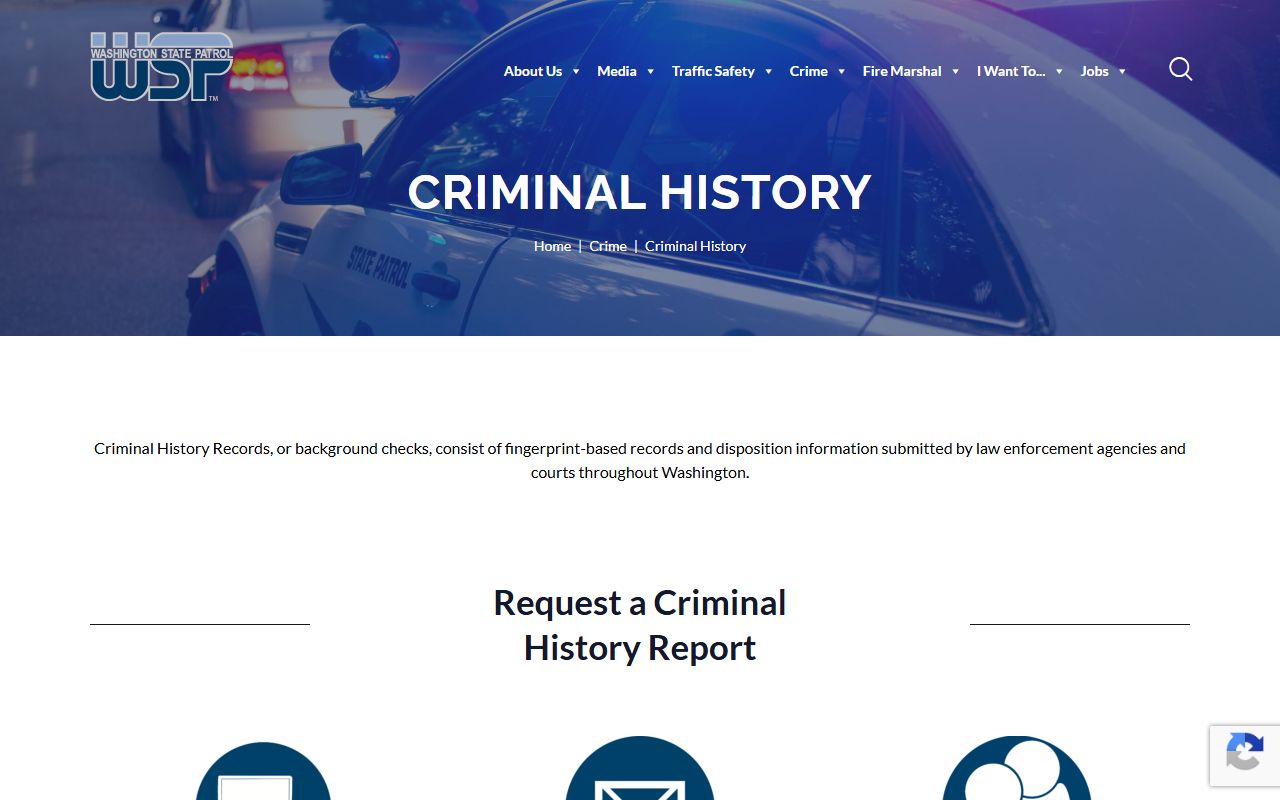
The WSP Criminal History Records section at wsp.wa.gov is where you start for statewide conviction history and background check requests.
The WATCH System for Criminal History Checks
The WATCH system (Washington Access to Criminal History) is the WSP's web-based background check service. You enter a full name and date of birth, and within seconds the system returns one of several results. If no record exists, you get a "No Record" response. If a match is found, you receive a RAP sheet showing Washington conviction history. The system may also return a "No Exact Match," a "Candidate List" of possible matches, or a "Duplicate Match" when two people share the same name and birthday. WATCH costs $11.00 per name and accepts Visa, MasterCard, and American Express. Organizations running many searches can apply for a billed account or nonprofit account by sending the application to WSP Identification and Background Check Section, PO Box 42633, Olympia WA 98504-2633, or by email to WATCH.Help@wsp.wa.gov.
A WATCH RAP sheet includes all Washington State criminal conviction history, adverse court findings, arrests less than one year old without a final disposition, sex and kidnapping offender registration status, and Department of Corrections data such as incarceration and supervision history. It does not report out-of-state convictions. The search is name and date of birth based, not fingerprint based. That means results may miss records tied to aliases or name variations, and identical names on different people can complicate results. For a more definitive identification, the WSP offers fingerprint-based background checks for $58.00, submitted by mail. A notarized letter adds $10.00. A mail-based name and date of birth request costs $32.00. Walk-in fingerprinting at the Olympia office costs $16.00 and the office is open Monday through Friday, 8:00 a.m. to 5:00 p.m., closed noon to 1:00 p.m. The physical address is 106 11th Ave SW Suite 1300, Olympia, WA 98501. Phone: (360) 534-2000.
The WATCH online portal is available around the clock. Most searches return results instantly.
The WSP Criminal History page has the full request form for mail-based checks, fee schedules, and instructions for each request method.
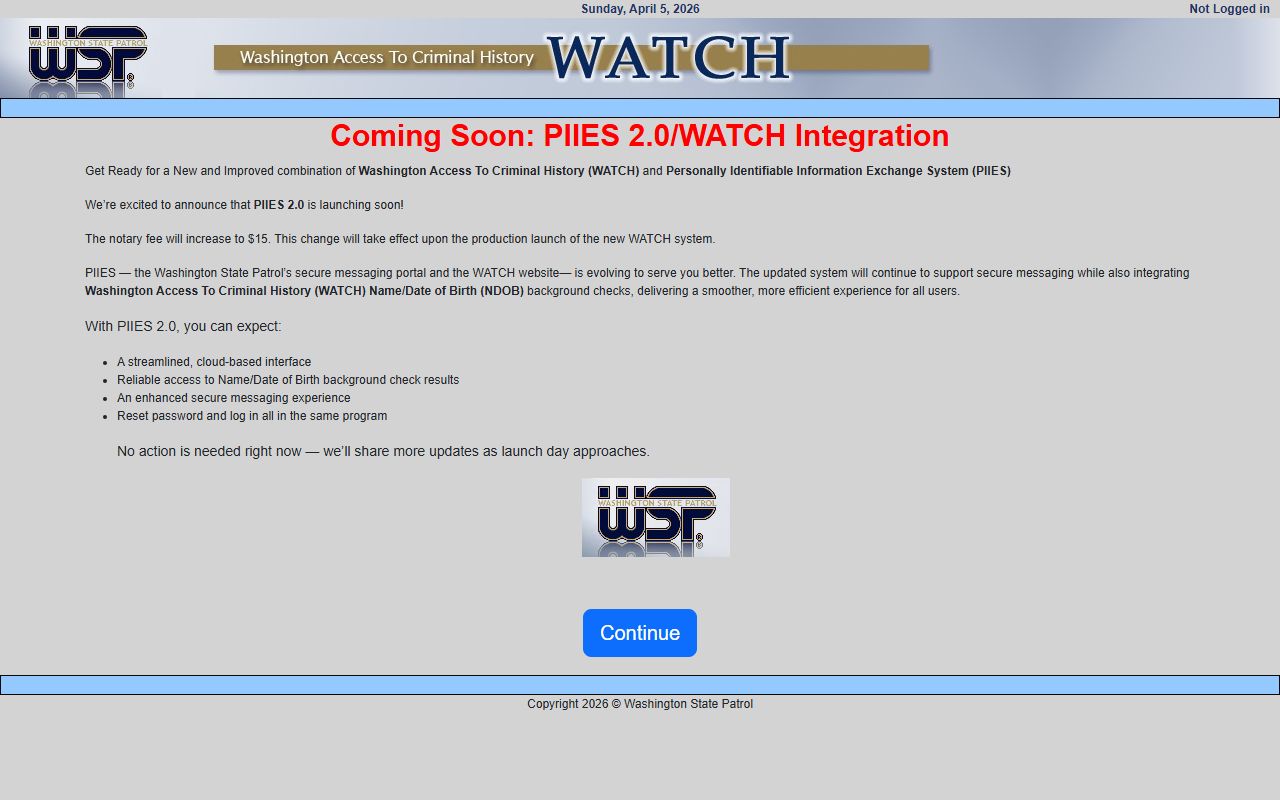
The WATCH system at watch.wsp.wa.gov provides instant online access to Washington State conviction criminal history for $11 per search.
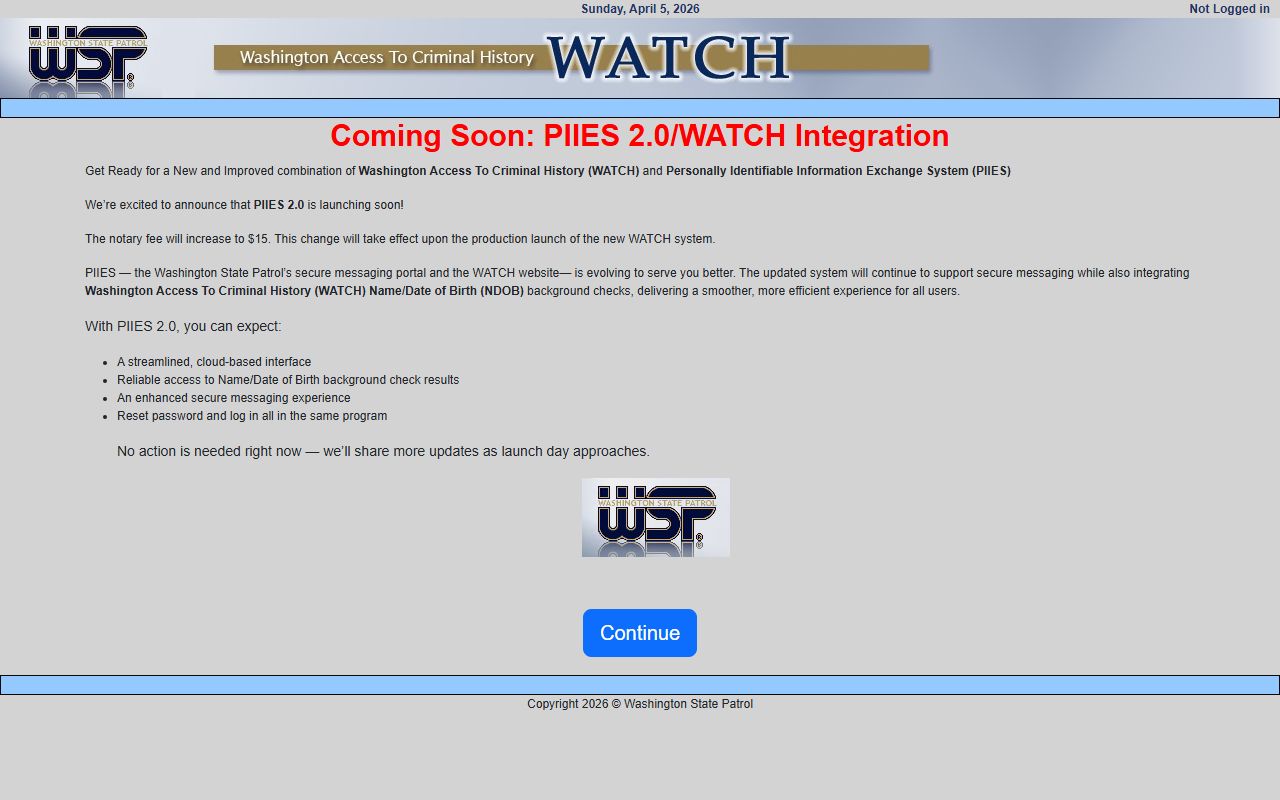
WATCH account holders can log in and run searches at any time. Billed account applications are handled by the WSP Identification Section in Olympia.
Washington Court Records Search
The Washington State Courts Name and Case Search gives public access to case information from Superior, District, Municipal, and Appellate Courts across Washington. You can search by person name, case number, attorney name, or judicial officer. Results show party names, case status, docket entries, hearing schedules, and charge information for criminal cases. The portal is free. Document images are not available through this portal. For actual case documents or certified copies, you go to the County Clerk directly.
Some counties operate their own supplemental portals with more detail. Spokane County runs the Court Viewer system, which allows searches of both Superior and District Court records by name or case number. Pierce County uses the LINX system. Clark County offers the Odyssey Portal at odysseyportal.courts.wa.gov. King County has its own KC Script case search at dja-prd-ecexap1.kingcounty.gov. When the statewide portal doesn't show enough, check the county's own tool. Larger counties often have more case information online including document-level detail.
Court records in Washington are presumptively open to the public under General Rule 31. The rule covers case files, dockets, judgments, orders, and hearing schedules. Personal identifiers including social security numbers and financial account numbers are redacted before public access under GR 31(e)(2). Parties and their attorneys are responsible for those redactions, not the court or clerk.
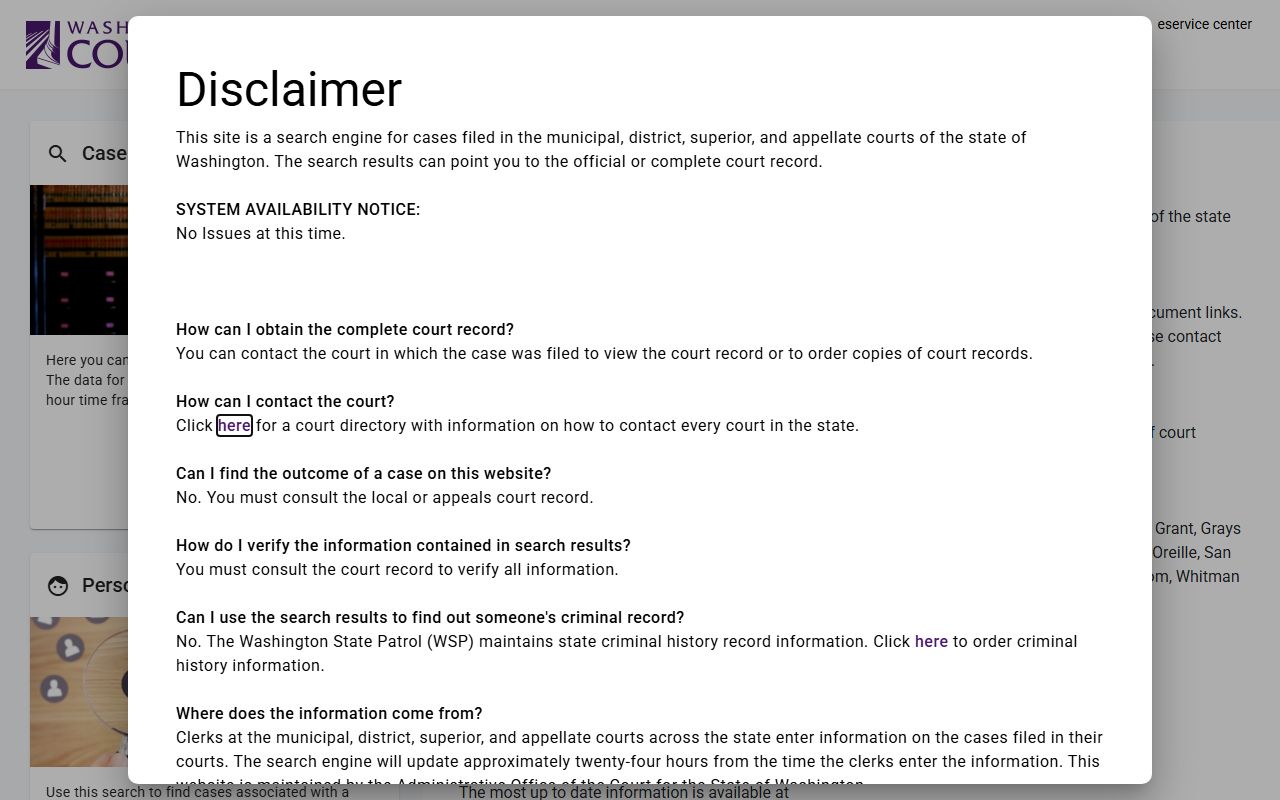
The Washington Courts case search at dw.courts.wa.gov covers courts across all 39 counties and is available at no cost.
The Washington State Court Directory lists every court in the state with addresses, phone numbers, and hours. If you need contact information for a specific court or clerk, that directory covers the full list.
Searching DOC Inmate Records
The Washington State Department of Corrections publishes information on currently incarcerated individuals through its online search tool. You can look up someone by DOC number or by first and last name. The DOC incarcerated data search shows age, facility location, and custody status. The DOC operates major state correctional facilities including Monroe Correctional Complex, Washington State Penitentiary in Walla Walla, Coyote Ridge Corrections Center, Stafford Creek Corrections Center, Nisqually Public Safety Complex, and Washington Corrections Center. If someone is serving a state sentence, they should appear in this lookup. The DOC search covers people currently in state custody, not county jail.
For records from the DOC beyond what the online search shows, the Public Disclosure Unit handles formal requests. Contact them by email at publicdisclosureunit@doc1.wa.gov, by phone at (360) 725-8213, or in person at 7345 Linderson Way SW, Tumwater, WA 98501. Fees: printed copies are 15 cents per page, electronic copies are 10 cents per page.
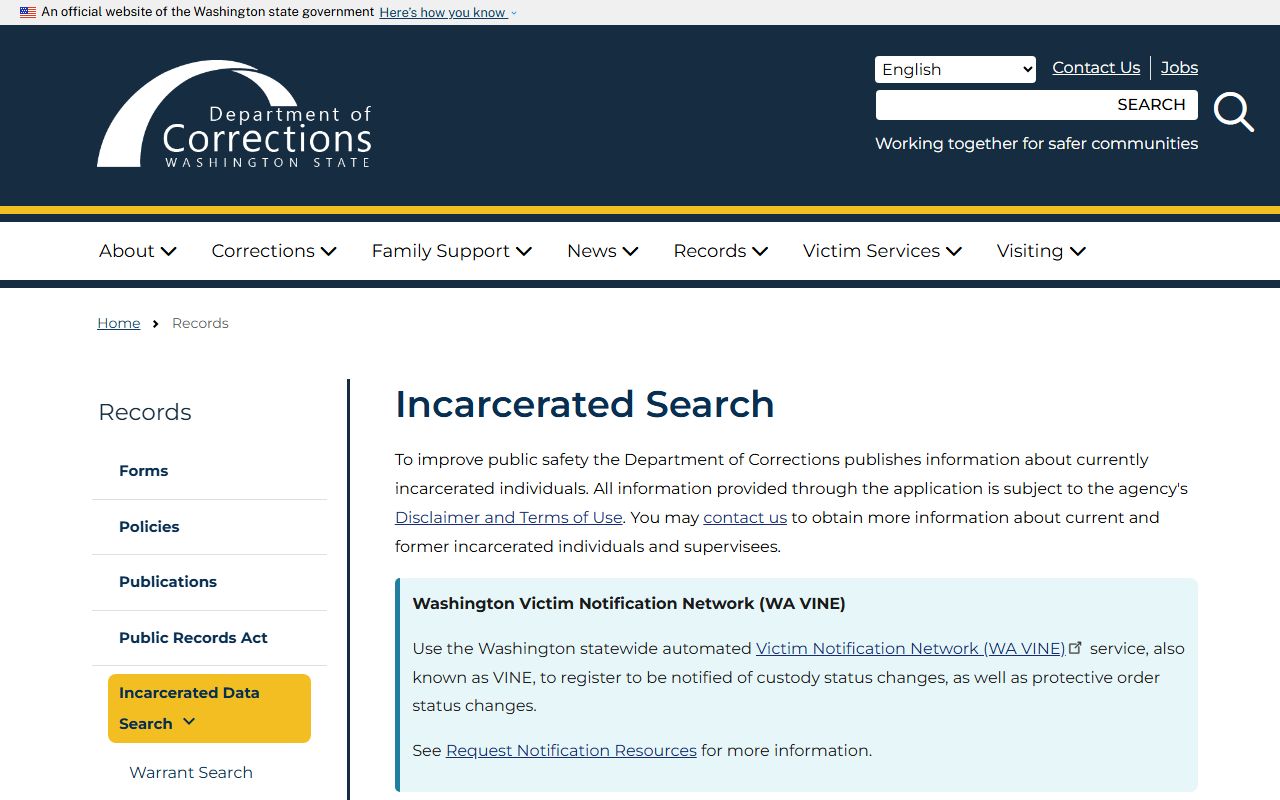
The DOC inmate search at doc.wa.gov shows custody status and facility location for people currently serving state sentences in Washington.
Washington Sex Offender Registry
The Washington Association of Sheriffs and Police Chiefs (WASPC) administers the Washington Sex Offender Public Registry (WASOR). County sheriffs handle registration for people living in their counties. The system uses a three-tier risk classification. Level I offenders are low risk. Their information is shared with law enforcement but is not posted on the public website. Level II offenders are moderate risk. Their information may be shared with schools, childcare centers, and neighbors near their home. Level III offenders are high risk. Their information goes out broadly through active community notification. Level II and III offenders appear on the public registry at wasor.org. You can also search the federal national database at nsopw.gov for a broader search that includes other states.
Under RCW 9A.44.130, registered offenders must report within three business days of release from custody, report any change of address or employment within three business days, and register in person at the county sheriff's office. Duration of registration depends on offense class. Class A felony offenders and those with prior sex or kidnapping convictions register indefinitely. Class B offenders without priors may petition for removal after 15 years in the community without incident. Class C offenders without priors come off the registry after 10 consecutive years in the community. Failure to register is itself a criminal offense under RCW 9A.44.132. A first felony failure to register is a Class C felony. Two or more prior felony failures to register is charged as a Class B felony.
WASPC Program Coordinator Terrina Peterson can be reached at (360) 486-2386 or tpeterson@waspc.org for registry-related inquiries.
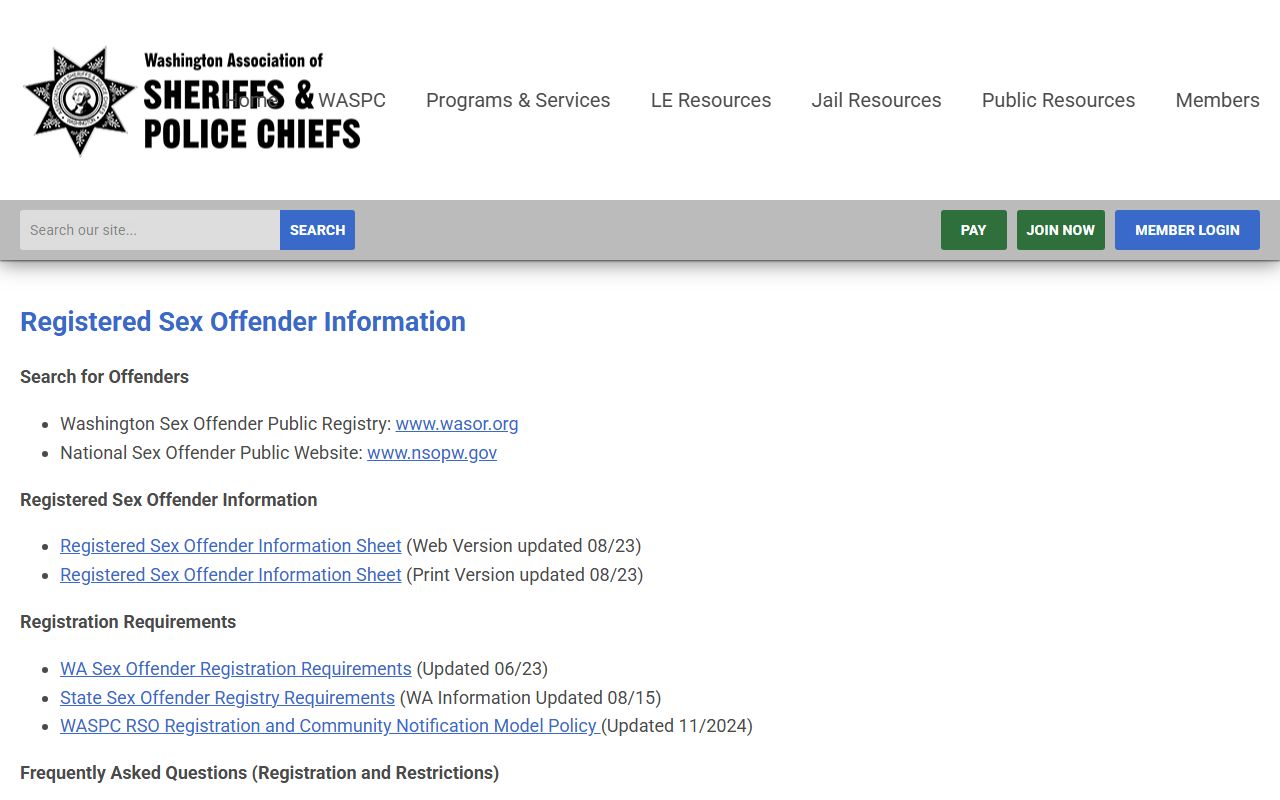
The WASPC sex offender information page at waspc.org explains the registry process, risk levels, and links to the public WASOR search tool.
What Washington Criminal Records Contain
A conviction criminal history RAP sheet from the WSP includes all Washington State convictions for a person, adverse court findings, arrests less than one year old still pending a disposition, sex and kidnapping offender registration status, and Department of Corrections data. The RAP sheet is built from submissions made by law enforcement and courts statewide. Each conviction entry shows the charge, court, date, and outcome. Fingerprints are used to link submissions together and verify identity across multiple agencies and counties.
Court case files at the county level contain far more detail. A criminal case file typically includes the charging document, any plea agreements, hearing transcripts or notes, motions from both sides, trial exhibits, verdict, sentencing orders, probation terms, and post-conviction filings like appeals or motions to vacate. The complete case file sits with the Clerk of the Superior Court for felony cases and the District Court Clerk for misdemeanor cases. Public access is the default under Washington's Public Records Act (RCW Chapter 42.56) and General Rule 31. Social security numbers, financial account numbers, and certain personal data are redacted before public release per GR 31(e)(2). Some categories of records carry additional restrictions. Juvenile files, sealed records, and certain victim and witness information are protected under separate statutes.
Arrest records at the county and city level include booking information, mugshots in many cases, charges at time of arrest, and release dates. These are separate from the court case file. Booking records are held by the jail. Arrest reports are held by the arresting agency.
How to Request Washington Criminal Records
For conviction criminal history from the WSP, you have three options. Online through WATCH is the fastest at $11 per search. By mail costs $32 for a name and date of birth request. A fingerprint-based check by mail costs $58. All mail requests go to Washington State Patrol, PO Box 42633, Olympia, WA 98504-2633. The agency typically responds within five business days, consistent with the response deadline under RCW 42.56.520.
For court case records, contact the County Clerk or District Court Clerk where the case was filed. Most clerks take in-person and mail requests. Some accept online requests. Copy fees are generally $0.50 per page for uncertified copies. Certified copies typically cost $5.00 for the first page plus $1.00 for each additional page. Some counties charge a $30.00 research fee for requests without a case number. Standard records request forms are available on the Washington Courts forms page. Courts operate under their own rules rather than the Public Records Act, so timelines and processes may differ from other government agencies.
For arrest records from a Sheriff's Office or city police department, submit a public records request to that agency directly. Each agency has its own form and process. Under the Public Records Act, most agencies must respond within five business days, though production of the actual records may take longer depending on volume and redaction requirements.
Fee waivers for court costs may be available. Ask the clerk about the waiver process if you have limited income.
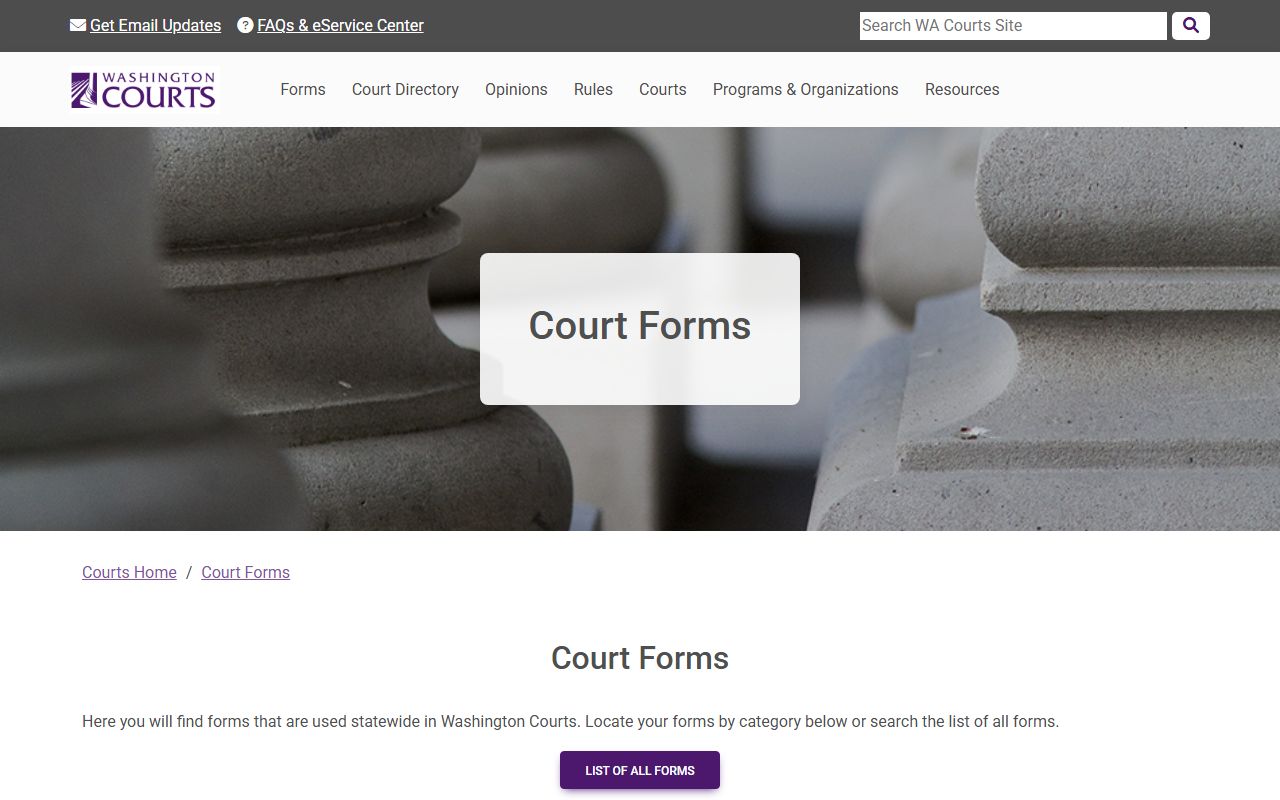
The Washington Courts forms page at courts.wa.gov/forms has downloadable forms for records requests, subpoenas, and related court processes.
Washington Criminal Records Privacy Laws
The Washington State Criminal Records Privacy Act (RCW Chapter 10.97) sets the rules for how criminal history record information is collected, kept, and shared. The statute declares that completeness, accuracy, confidentiality, and security of criminal history records are state policy. Under RCW 10.97.050, conviction records may be shared freely. Agencies may also share data about incidents where someone is currently being processed in the criminal justice system. Non-conviction data, including charges that were dropped or that resulted in acquittal, carries tighter disclosure limits. That information is generally restricted to criminal justice agencies and is not available to the general public.
Under RCW 10.97.080, the subject of a criminal history record has the right to inspect and review their complete file, including non-conviction information, after verifying their identity. Under RCW 10.97.060, non-conviction records may be deleted from the Washington Automated Information System (WASIS) upon the subject's request when no active proceedings are pending. Washington also runs a Compromised Identity Claim program for people whose personal information was used by another person at the time of arrest. The program issues a wallet card bearing the claimant's name, SID number, photograph, and thumbprint. A notation is added to all future background check results to prevent confusion.
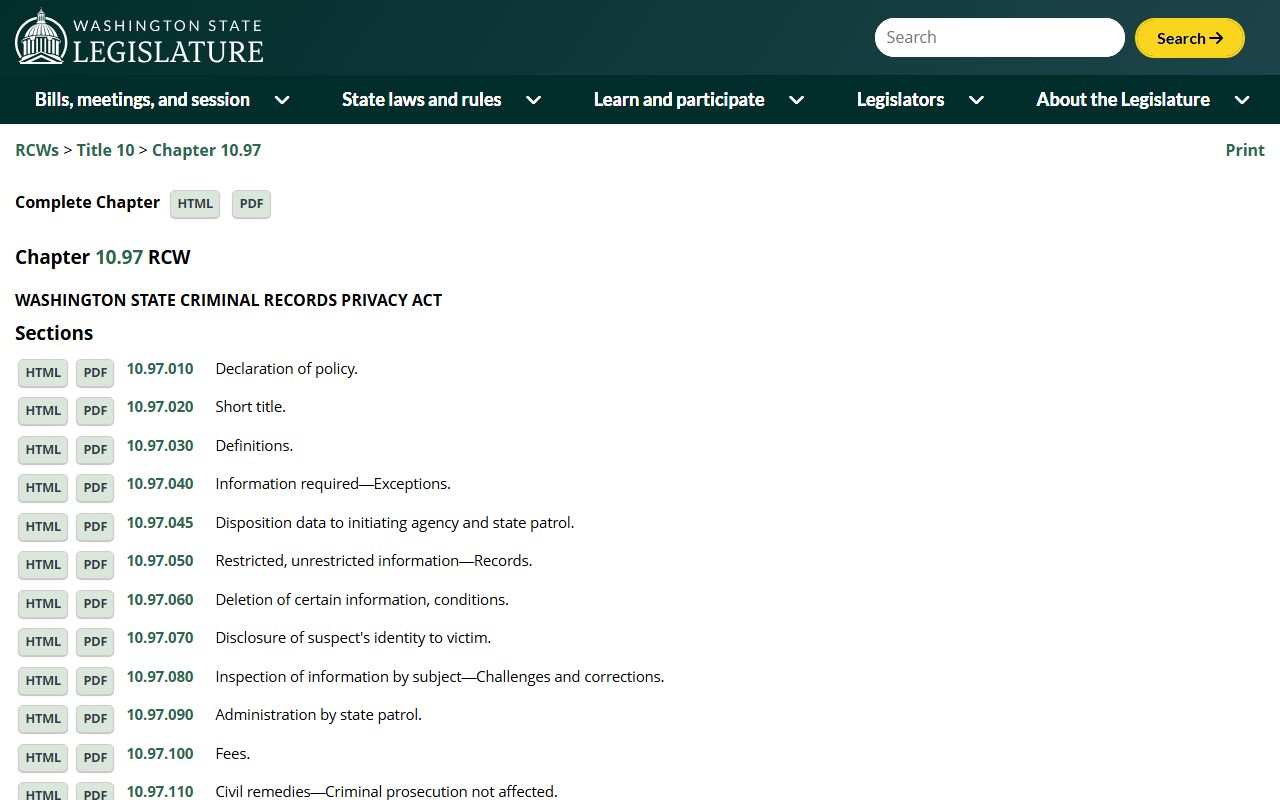
RCW Chapter 10.97 at apps.leg.wa.gov is the governing statute for how Washington handles criminal history record information.
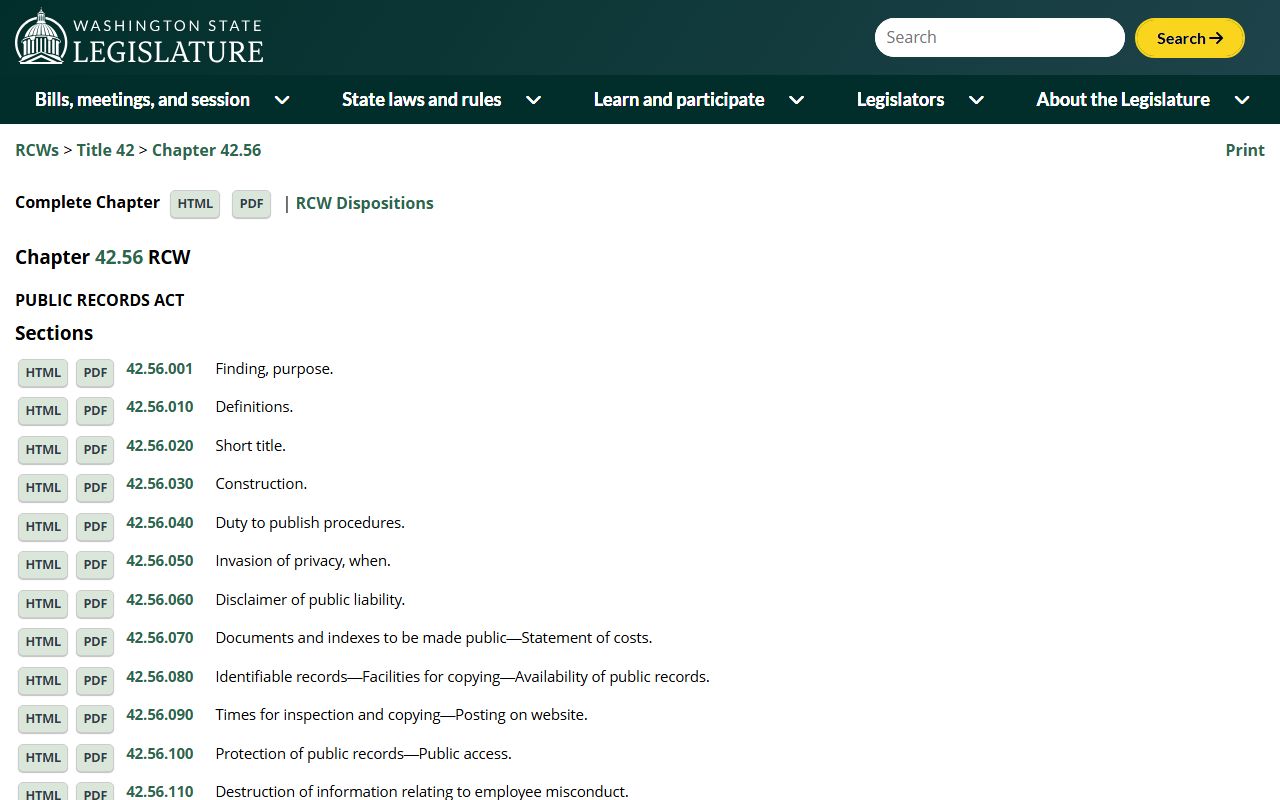
RCW Chapter 42.56, the Public Records Act, governs access to records held by state and local government agencies, with important carve-outs for court records and criminal history data under RCW 10.97.
Juvenile Criminal Records in Washington
Washington RCW Chapter 13.50 governs how juvenile records are kept and released. Juvenile records fall into three categories: the official juvenile court file, the social file (probation records), and other juvenile justice agency records. Only the official juvenile court file is treated as a public record. The social file and other juvenile records are confidential and may only be released under specific limited circumstances spelled out in statute. The Public Records Act does not apply to juvenile records covered by Chapter 13.50, which means standard public records requests do not reach sealed or confidential juvenile files.
Juvenile records can be sealed or destroyed. Sealing removes the record entirely and treats the matter as though it never happened for most purposes. Destruction is available for certain diversion records. If you want to explore sealing a juvenile record, the Washington Courts website has forms and eligibility information available on the court forms page.
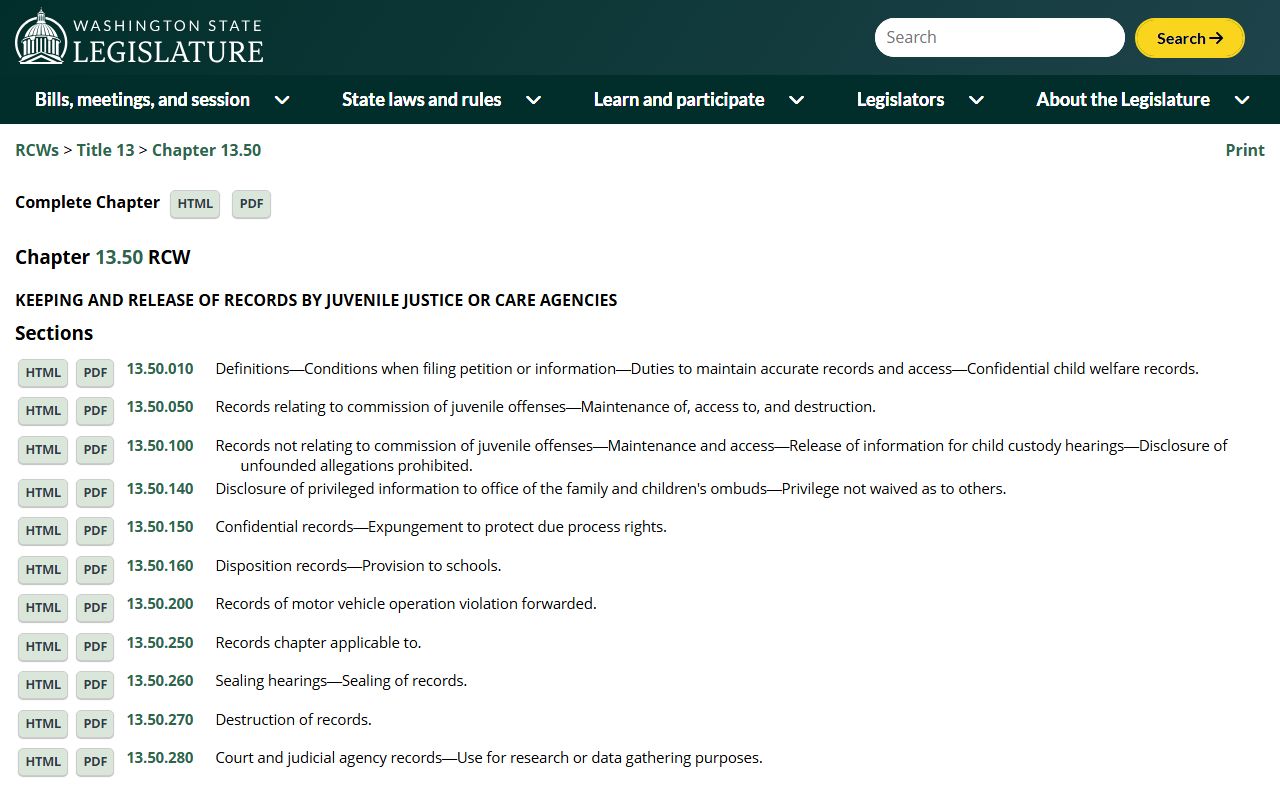
RCW Chapter 13.50 at apps.leg.wa.gov covers what is public, what is confidential, and the process for sealing or destroying juvenile records in Washington.
Washington State Digital Archives
The Washington State Digital Archives holds digitized historical court records and government documents. These include superior court case files from several counties going back to the territorial era. Chelan County Superior Court case files from 1950 to 2022 are a notable example. You can search by name, case number, date range, or county. Sealed or confidential documents do not appear in the search results. Some case documents are viewable directly online. Copies of full case files can be ordered through the portal. The archives are most useful for older cases, historical research, and records that may no longer be on-site at the originating court.
Coverage varies by county. Not every county has the same depth of digitized records in the archive. For recent cases, the county court clerk and the statewide courts portal are more reliable starting points.
The Washington State Digital Archives at digitalarchives.wa.gov provides online access to historical court records from multiple counties.
Firearms Background Checks in Washington
The WSP Firearms Background Division processes background check requests submitted by licensed firearms dealers during gun sales. The division reviews criminal history, mental health records, and other disqualifying factors to determine whether a purchase can proceed. Washington is a "shall issue" state for concealed pistol licenses, subject to certain disqualifying conditions. If a court restores someone's firearm rights after a conviction, the WSP processes the court order and updates both the state record and the FBI file to reflect the restoration. For questions about a firearm purchase denial or appeal, contact the FBI NICS Department at (877) 324-6427.
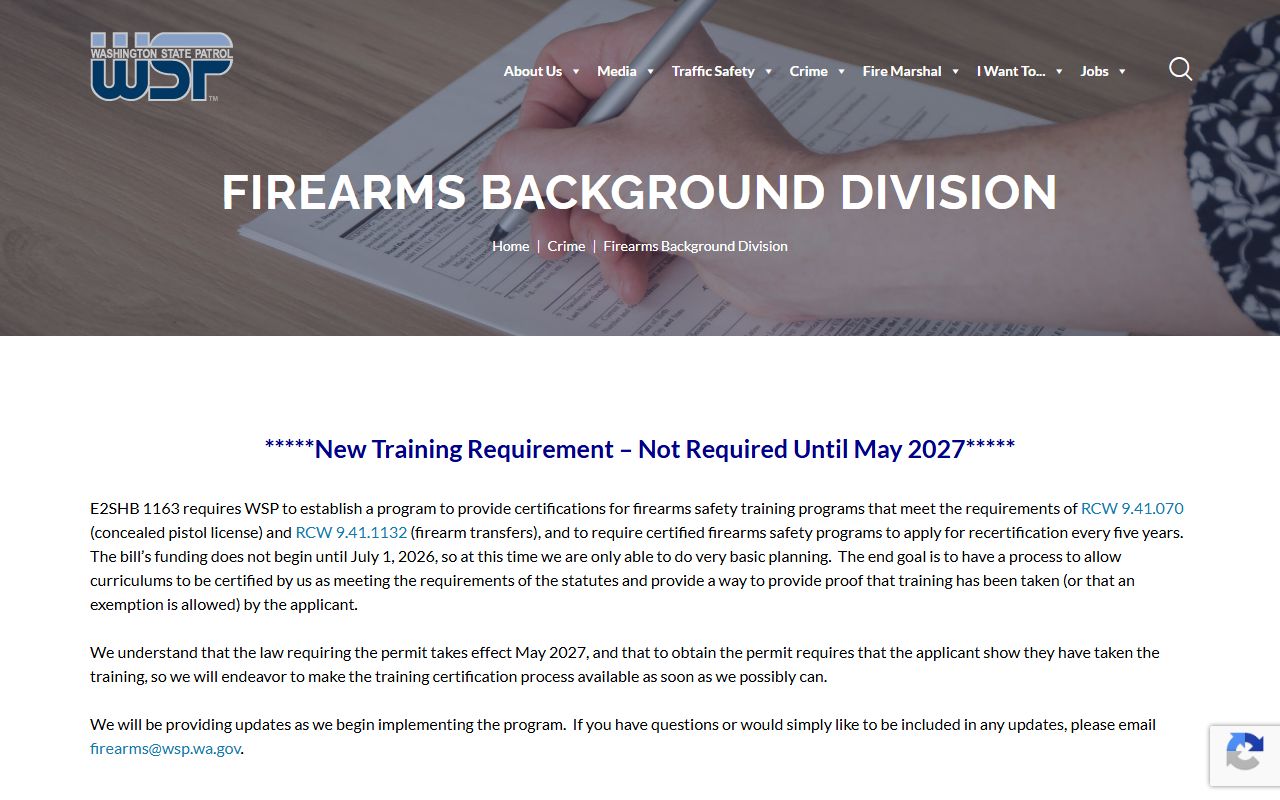
The WSP Firearms Background Division at wsp.wa.gov processes dealer-submitted background checks for all firearm purchases in Washington State.
Court Rules and Access to Washington Records
Washington Court General Rule 31 governs public access to court records across all courts in the state. The rule presumes that court records are open to the public unless a statute, court rule, or specific court order restricts them. Records covered include case files, dockets, judgments, orders, hearing schedules, and administrative records. Under GR 31(e)(2), the responsibility for redacting personal identifiers rests on the parties and their attorneys, not on the court staff or clerk. Required redactions include social security numbers, financial account numbers, home addresses in certain case types, and the full names of minor children. The full text of Washington Court Rules including GR 31 is available on the courts website.
Not every court makes records available the same way. Some courts have public access terminals where you can review files at no cost. Others require a written request and may charge fees. Courts operate on their own rules rather than the Public Records Act, so their timelines differ from other government agencies. The five-business-day rule under RCW 42.56.520 applies to executive-branch agencies, not courts. Most courts try to respond promptly but timelines depend on staffing and request volume.
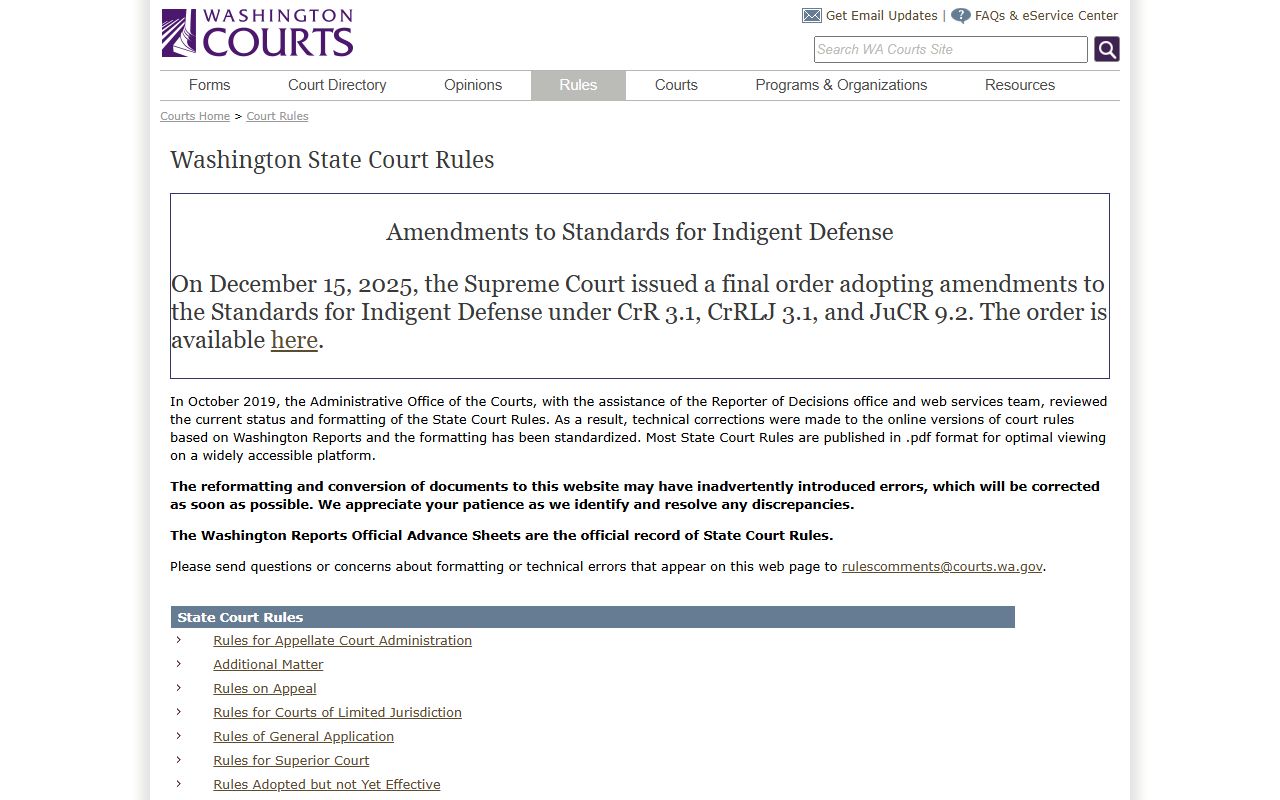
Washington Court General Rule 31, found at courts.wa.gov/court_rules, establishes the presumption of open access to court records statewide.
The Washington State Court Directory at courts.wa.gov lists every court in the state with address, phone number, and hours for each location.
Browse Washington Criminal Records by County
Each of Washington's 39 counties has its own Superior Court, District Court, and Sheriff's Office maintaining criminal records for cases filed locally. Select a county to find court contacts, local search portals, and resources specific to that area.
View All 39 Washington Counties
Washington Criminal Records by City
Major Washington cities are served by county courts, and many have their own municipal courts for local misdemeanor cases. Select a city to find court contacts and criminal record resources for that area.